
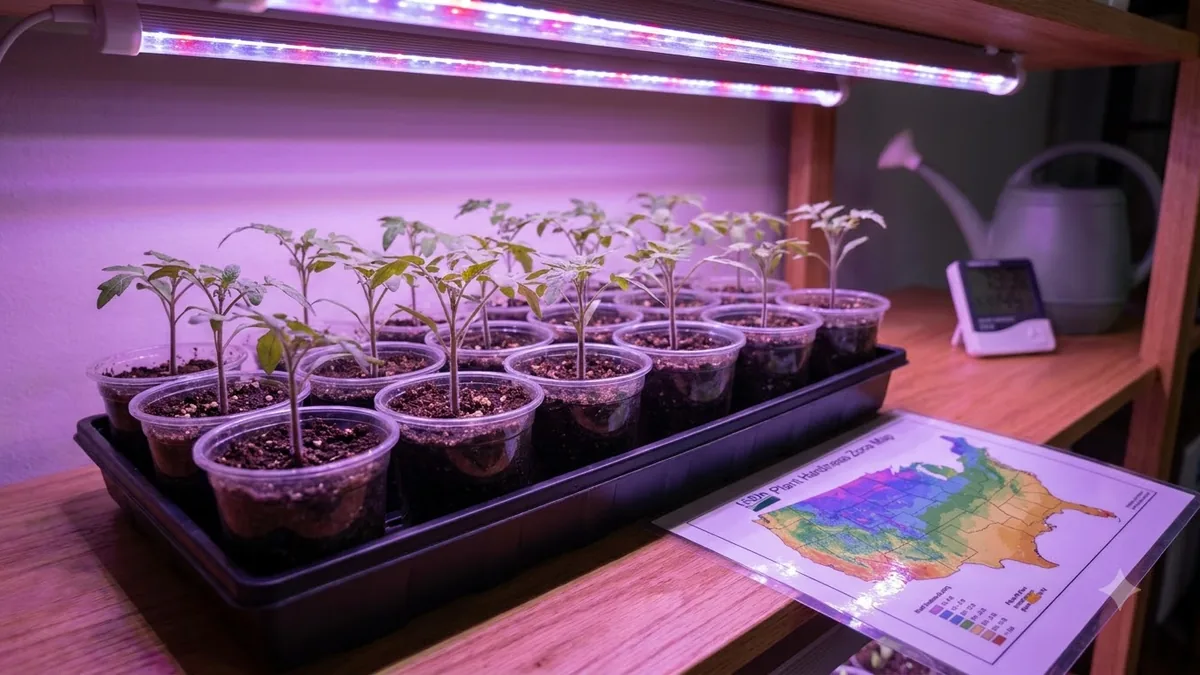
If you've typed "when to plant tomatoes in my zone" into a search bar, you've probably noticed that most calendars just say "after your last frost" without ever telling you what that date actually is where you garden. Your USDA hardiness zone is a useful starting point, but the two things that really decide your planting schedule are your area's average last frost date and the actual temperature of your soil -- not the month on the calendar.
The short answer: start tomato seeds indoors 6 to 8 weeks before your area's average last frost date, then transplant seedlings outdoors 2 to 3 weeks after that last frost, once nighttime temperatures are reliably staying above about 50°F. The zone chart below gives typical ranges for USDA zones 3 through 11 -- use it to get in the right ballpark, then confirm the exact dates with a local frost-date tool.
Below, we'll walk through how to find your precise numbers, a full planting guide by zone, and exactly how to time seed starting, hardening off, and transplanting so your tomatoes never sit outside cold or come inside leggy.
The Two Dates That Actually Matter
USDA hardiness zones are built from average annual minimum winter temperatures, which is useful for choosing perennials but only loosely tied to when spring frost risk actually ends where you live. Your average last frost date is the number that should drive your tomato schedule -- it's the point after which frost becomes unlikely (though never impossible) in a typical year.
The second number gardeners skip is soil temperature. Tomato roots stall out in cold soil even if the air feels warm enough, so a transplant date that only accounts for frost risk can still set your plants back weeks. That's why the guidance in this article is built around both dates working together, not the calendar month alone.
Tomato Planting Dates by USDA Zone
Use this table as a general planning guide for when should i plant tomatoes based on zone. These are typical ranges, not guarantees -- your actual last frost date depends on elevation, coastal proximity and local microclimate, so treat the zone as a starting point and confirm with a local frost-date tool before you commit seedlings to the ground.
| Zone | Typical Last Frost | Start Seeds Indoors | Transplant Outdoors |
|---|---|---|---|
| Zone 3 | Late May – mid-June | Late March – mid-April | Early June – early July |
| Zone 4 | Early – late May | Mid-March – early April | Mid-May – mid-June |
| Zone 5 | Mid-April – mid-May | Late February – mid-March | Late April – late May |
| Zone 6 | Early – late April | Early – late February | Mid-April – mid-May |
| Zone 7 | Late March – mid-April | Late January – mid-February | Early – late April |
| Zone 8 | Late February – late March | Late December – late January | Mid-March – mid-April |
| Zone 9 | Early – late February | Early – late December | Mid-February – mid-March |
| Zone 10 | Mid-January – mid-February | Late November – late December | Late January – early March |
| Zone 11 | Essentially frost-free | Anytime; fall is typical for a spring crop | Year-round, with January – February the strongest window |
Zone 7 covers a wide swath of the country, and dates shift noticeably within it depending on elevation and how close you are to open water. Zone 8 splits into two common sub-bands worth calling out specifically: if you're asking when to plant tomatoes in zone 8a, expect a last frost around mid-to-late March, with seeds started indoors in mid-to-late January and transplant landing in early-to-mid April -- roughly two to three weeks earlier than the warmer 8b pockets closer to the coast.
How to Find Your Exact Zone and Last Frost Date
The zone chart above gets you close, but a real tomato planting guide should end at your specific address, not a nine-zone average. Start by confirming your USDA hardiness zone with your ZIP code on the official USDA Plant Hardiness Zone Map -- zone boundaries have shifted in recent years and your assumed zone may be out of date.
From there, look up your average last spring frost date through a local agricultural extension office or a frost-date calculator that uses your specific ZIP code rather than your broader zone. These tools pull from decades of local weather station data, which is far more precise than a zone-wide average, especially if you're in a valley, near a large body of water, or at a noticeably different elevation than the rest of your region.
- Keep your own log. Note the date of your last actual spring frost each year -- after three or four seasons you'll have a more reliable number than any online tool.
- Ask neighbors with established gardens. Long-time local gardeners usually know the real transplant window better than a national average does.
- Remember "average" means 50/50. An average last frost date still carries meaningful odds of a late frost after it, which is part of why the transplant window sits two to three weeks past that date rather than right on it.
Starting Tomato Seeds Indoors
Once you know your target transplant date, count backward 6 to 8 weeks to get your seed-starting date -- that's the timeline behind every row in the zone table above. Sow seeds a quarter-inch deep in a seed-starting mix, and keep the soil at 70 to 80°F for the fastest, most even germination. A seedling heat mat makes a real difference here; tomato seeds sown in cold soil can take two to three times longer to sprout, and germination rates drop.
Expect seedlings to emerge in 5 to 10 days at the right soil temperature. Once they're up, move them under strong light immediately -- a sunny windowsill is rarely bright enough on its own and tends to produce thin, stretched ("leggy") seedlings. Grow lights positioned 2 to 3 inches above the plants for 14 to 16 hours a day, combined with a small fan to strengthen stems, will get you sturdier transplants.
Gardeners asking when to start tomato seeds indoors zone 6 or when to start tomato seeds indoors zone 7 are usually looking at a window in early-to-late February for zone 6 and late January to mid-February for zone 7, based on the last-frost ranges above. If your transplant date shifts once you confirm your exact local frost date, just recount 6 to 8 weeks back from that new date.
Hardening Off Before Transplanting
Seedlings raised entirely indoors have never dealt with direct sun, wind or temperature swings, and moving them straight from a windowsill to the garden bed shocks them badly. Skipping this step is one of the most common reasons transplants stall, scorch or die within days of being set outside -- even when the frost risk itself has genuinely passed.
Hardening off is a gradual, 7-to-10-day process of toughening seedlings up before their final move:
- Days 1–2: Set plants outside in a sheltered, shaded spot for 1 to 2 hours, then bring them back in.
- Days 3–5: Increase outdoor time to 3 to 4 hours and introduce a little direct morning sun.
- Days 6–8: Extend to most of the day, including a few hours of stronger afternoon sun, and let them experience light wind.
- Days 9–10: Leave plants outside overnight if nighttime temperatures are safely above 50°F, then transplant.
Watch the plants, not just the calendar, during this stretch -- if leaves start to bleach or curl in strong sun, pull the pace back a day or two before continuing.
Signs It's Safe to Transplant Outdoors
Even with a target date circled on the calendar, it's worth confirming conditions before you commit hardened-off seedlings to the ground. Look for all three of these signs together, not just one:
- Soil temperature above 60°F at planting depth (about 4 inches down), checked with a simple soil thermometer rather than guessed from air temperature.
- No frost in the 10-day forecast, including no unusually cold overnight lows that could sneak in behind a passing front.
- Nights consistently staying above 50°F. Tomatoes set outside too early with cold nights don't die, but they often sulk in place for weeks without producing new growth.
If any one of these isn't true yet, it's almost always worth waiting rather than rushing. A tomato transplanted two weeks "late" into warm soil will typically catch up to and pass one planted two weeks "early" into cold soil.
How to Read a Soil Thermometer the Right Way
A soil thermometer is one of the cheapest tools in a vegetable garden, but most gardeners either skip it entirely or use it wrong. A single soil temperature reading taken at the wrong time of day tells you almost nothing useful -- soil temperature swings several degrees between early morning and late afternoon, especially in the top few inches where a new transplant's roots first establish themselves.
For a reading that actually reflects planting conditions, push the probe into the bed to a depth of about 4 inches -- roughly where a transplant's root ball will sit -- and take the reading in the morning, before the sun has had a chance to warm the surface. A single morning reading is a snapshot, not a trend, so check at the same time for several consecutive days and average the results rather than acting on one unusually warm afternoon. According to Ohio State University Extension's guidance on checking soil temperature before planting tomatoes, few gardeners take this step even though soil temperature is one of the biggest factors in how well a transplant establishes.
If your readings hover in the mid-50s, hold off -- tomato root growth essentially stalls below about 50°F and won't resume normal function until the soil warms into the 60s, regardless of how mild the air feels during the day. A string of mornings at 60°F or warmer, combined with the frost-free forecast and steady overnight temperatures covered above, is the real green light to transplant.
Protecting Early Transplants From a Surprise Late Frost
Even gardeners who wait for every recommended sign can still get caught by a late cold snap -- an average last frost date is exactly that, an average, and a colder-than-usual front can roll through after transplants are already in the ground. Having a frost-protection plan ready before you plant is far less stressful than scrambling for materials the night a frost warning is issued.
Floating row covers are the simplest option for most home gardens. Draped loosely over hoops or a low frame so plants have room to grow underneath, a lightweight row cover can add several degrees of protection on a frosty night. Cover plants before sunset while the day's heat is still held in the soil, and pull the cover back off the next morning once temperatures rise back above freezing, so plants aren't trapped under fabric in full sun. Per the University of Maryland Extension's guide to row covers, this kind of cover can provide several degrees of frost protection while also shielding young plants from wind and early-season pests.
For gardeners who want to push their transplant date even earlier, a "water wall" -- a ring of water-filled plastic tubes set around an individual plant -- absorbs heat during the day and releases it slowly overnight, insulating a single transplant well enough that some gardeners use them to set tomatoes out weeks ahead of the normal window. Water walls take up storage space and are more effort per plant than a row cover, so they tend to make the most sense for a handful of prized early tomatoes rather than an entire bed.
Whichever method you choose, treat it as backup insurance rather than a reason to ignore the guidance above -- frost protection buys you a few degrees, not immunity, and a hard freeze can still damage covered plants if temperatures drop far enough.
Succession Planting a Second Round of Tomatoes in Long-Season Zones
Gardeners in zones 8 through 11 often have enough frost-free days to grow more than one tomato crop between the last spring frost and the first fall frost. If your growing season runs much longer than the roughly 12 to 15 weeks a tomato plant needs from seed to first harvest, a second planting can noticeably extend your fresh-tomato window rather than leaving the garden to decline once the first planting passes its peak.
The general approach is to start a second round of seedlings, or set out a second batch of transplants, roughly 5 to 6 weeks after the first planting goes in the ground -- timed so the new plants begin producing right around when the first planting's yield starts to taper off. In hot-summer regions, gardeners often plant in spring, ride out a slowdown through the most extreme summer heat when blossoms drop instead of setting fruit, then put in a second round in late summer for a fall harvest. Choosing a heat-tolerant variety for that second planting matters more than hitting an exact calendar date, since an ordinary variety may simply refuse to set fruit through peak summer heat no matter when it went in the ground.
Gardeners in zones 3 through 7 generally don't have the frost-free window for a true second planting, but a related trick still applies: starting a small backup batch of seedlings two to three weeks behind your main planting gives you replacement plants on hand if an early transplant is lost to a late frost, at no real cost if it turns out you don't need them.
Frequently Asked Questions
When should I plant tomatoes if I'm in zone 7?
For when to plant tomatoes zone 7, the average last frost typically falls between late March and mid-April. Start seeds indoors from late January to mid-February, then transplant outdoors from early to late April, once nights are reliably staying above 50°F.
When do I start tomato seeds indoors in zone 6?
In zone 6, the average last frost lands in early to late April, so start tomato seeds indoors roughly 6 to 8 weeks earlier -- early to late February -- under grow lights. Plan to transplant outdoors around mid-April to mid-May.
Can I plant tomatoes before the last frost date?
It's risky. Tomatoes are killed or badly damaged by any frost, and even frost-free nights below the mid-40s°F can stunt them permanently. Wait until 2 to 3 weeks after your average last frost date, when nights are consistently staying above about 50°F, before transplanting outdoors.
What happens if you plant tomatoes too early?
Tomatoes set out too early are exposed to cold soil and chilly nights that stunt root growth, even if no actual frost occurs. Plants often turn a dull purplish color, stop putting on new growth, and can take weeks to recover once the weather does warm up -- sometimes ending up smaller and less productive than tomatoes planted two or three weeks later into warmer conditions.
Can you plant tomatoes twice in one season in warm zones?
Yes, in zones 8 through 11 many gardeners plant tomatoes twice: once in early spring for a summer harvest, and again in mid-to-late summer for a fall crop. The second planting is usually timed so new plants start producing around the time the first planting's yield tapers off, often using a heat-tolerant variety to get through the hottest weeks.
How do you know your last frost date if you don't know your zone?
You don't need your USDA zone to find your last frost date -- a ZIP-code-based frost date calculator or your local agricultural extension office can give you that date directly from historical weather station records. Your hardiness zone is useful background information, but the last frost date itself comes from local frost history, not the zone number.
Do all tomato varieties follow the same planting schedule?
No. The frost-date and soil-temperature guidance is the same for every tomato variety, but time-to-maturity varies widely -- some cherry tomatoes produce ripe fruit in under 60 days, while many large slicing and beefsteak varieties need 80 days or more. Check the days-to-maturity on your seed packet and count forward from your transplant date to estimate your first harvest.
Is it better to direct-sow tomato seeds or transplant seedlings?
Transplanting seedlings is almost always the better choice for tomatoes. Because tomatoes need 6 to 8 weeks of indoor growth before it's safe to plant outside, direct-sowing seeds into the garden after your last frost pushes first harvest much later in the season -- and in short-season zones, seeds sown directly outdoors may not have enough frost-free days left to ripen fruit at all.
What soil temperature is too cold for tomatoes?
Soil below about 50°F is too cold for tomatoes -- root growth essentially stalls at that point, even if the plant doesn't show obvious damage. Aim for a consistent 60°F or warmer at 4 inches deep before transplanting; the closer the soil gets to 70°F, the faster a new transplant will establish.
Can you plant tomatoes in fall in warm climates?
Yes, in zones 9 through 11, fall is a legitimate second planting window. Set transplants out in late summer to early fall so they have enough warm weeks to establish and set fruit before nighttime temperatures drop too low for pollination, generally aiming for at least 10 to 12 weeks of warm weather remaining before your average first fall frost.
Conclusion
The zone chart above will get any gardener within a couple of weeks of the right schedule, but the real answer to when to plant tomato seeds and when to move them outside always comes down to your specific last frost date and the temperature of your actual soil. Pin down those two numbers for your exact location, count backward and forward from them, and the rest of this guide does the rest of the work.
Thanks for reading!