
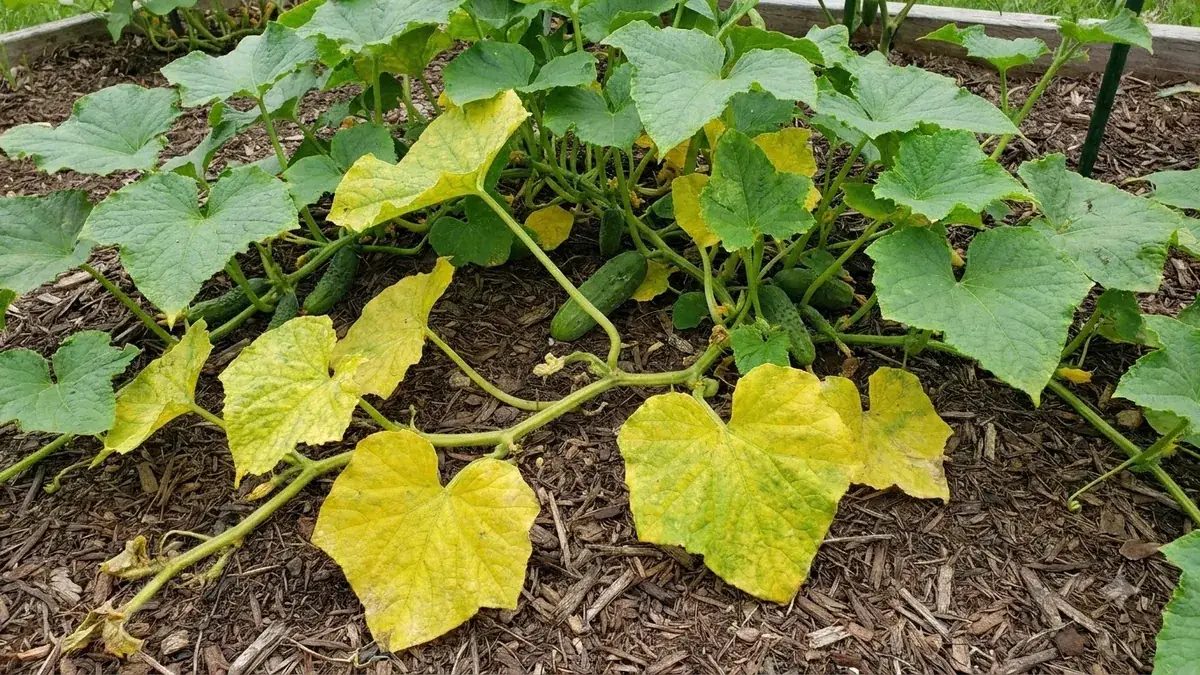
A cucumber vine that was solid green last week and speckled yellow this week is one of the most common complaints in the vegetable patch, and it can mean half a dozen different things. Before you reach for fertilizer or a fungicide, the fastest way to fix cucumber leaves turning yellow is to look closely at the pattern first -- where on the plant it's happening, and what the yellowing actually looks like up close.
The short answer: in rough order of likelihood, cucumber leaves turn yellow from water stress (too much or too little), nitrogen deficiency, powdery or downy mildew, natural aging of the oldest lower leaves, or -- less commonly but more seriously -- cucumber mosaic virus.
Below is a diagnostic framework to narrow it down fast, followed by exactly how to recognize and fix each cause, and how to keep it from coming back next season.
Start Here: What Does the Yellowing Look Like?
Before diagnosing anything, answer two questions: which leaves are affected (oldest and lowest, newest and topmost, or scattered throughout), and what shape is the yellowing (solid, spotted, coated, or mottled)? That combination points you toward the right section below almost every time.
- Solid yellow, lower leaves only, rest of the plant green -- almost always watering stress, nitrogen deficiency, or simple old-leaf aging. Start with the water and feeding sections.
- Yellow spots or patches, often angular and bounded by leaf veins -- this is the classic sign of downy mildew, especially if the undersides look water-soaked or fuzzy gray.
- Powdery white coating with yellowing underneath -- powdery mildew. Unmistakable once you see it; it looks like the leaf was dusted with flour.
- Mottled, blotchy yellow-and-green pattern across new growth, with stunted or curled leaves -- this points to cucumber mosaic virus, which needs a different response than the other causes.
If you're still not sure after reading this list, jump ahead to the cause that matches your leaves most closely -- each section below explains exactly what to look for.
What to Check First: A Five-Minute Triage Checklist
If you'd rather not read every section below, run through this checklist at the plant -- it takes about five minutes and will usually narrow things down to one or two likely causes before you've opened a fertilizer bag or a fungicide bottle.
- Touch the soil two inches down. Bone dry points toward underwatering; soggy or slow to drain points toward overwatering or root rot.
- Look at which leaves are affected. Oldest and lowest only usually means water stress, nitrogen deficiency, or normal aging. Newest and topmost points toward iron chlorosis or a nutrient lockout issue. Scattered throughout, especially with stunted new growth, raises the odds of a virus.
- Check texture, not just color. A dusty white coating means powdery mildew. Angular yellow patches boxed in by leaf veins mean downy mildew. Smooth, uniform yellow with no coating or spotting points toward a water or nutrient cause instead.
- Watch for sudden wilting alongside the yellowing. If whole leaves or runners are collapsing within a day or two, especially with cucumber beetles nearby, treat bacterial wilt as a suspect and run the stem test described further down.
- Check the fruit. Misshapen, stunted, or bitter fruit alongside a mottled yellow leaf pattern points toward mosaic virus rather than a simple watering or feeding issue.
Once you've narrowed it down using this list, jump to the matching section below for the full diagnosis and fix.
Overwatering or Poor Drainage
Cucumber roots need oxygen as much as they need water, and soil that stays saturated suffocates them. Overwatered leaves usually turn yellow starting at the base of the plant, feel soft or limp rather than crisp, and the soil itself will be visibly soggy or slow to drain. In containers or heavy clay soil, this is often the first cause to rule out.
How to fix it: Let the top 1-2 inches of soil dry out between waterings, and check that pots and beds actually drain -- add drainage holes or work compost into dense soil if water is pooling. If roots have been sitting wet for a while, pull one plant and check for brown, mushy roots, which signal root rot has already set in.
Underwatering
Cucumbers are roughly 95% water and have shallow root systems, so they're unusually quick to show drought stress. Underwatered leaves typically yellow and crisp at the edges first, the whole plant looks wilted even in the morning, and the soil is visibly dry a couple of inches down. This is especially common during a summer heat spell or with plants in small containers that dry out fast.
How to fix it: Water deeply and consistently rather than little and often -- cucumbers generally want about 1-2 inches of water a week, more during hot stretches. A layer of mulch around the base slows evaporation and evens out the swings between soaked and bone-dry that stress the plant.
Nitrogen Deficiency
Cucumbers are heavy feeders, and nitrogen is the nutrient they burn through fastest, especially once the vine starts setting fruit. Nitrogen deficiency shows up as pale, uniform yellowing that starts on the oldest lower leaves and works upward, since the plant pulls nitrogen from older growth to feed new growth first. Growth also tends to slow down and stems can look thinner than usual.
How to fix it: Feed with a balanced or slightly nitrogen-forward fertilizer, or side-dress with compost or aged manure. Avoid overcorrecting with a heavy dose of pure nitrogen once fruit has set, since that can push leafy growth at the expense of cucumbers. For a broader rundown of how nutrient shortages show up across different vegetable crops, see University of Maryland Extension's guide to nutrient deficiency in vegetable plants.
Powdery Mildew (White Coating + Yellowing)
Powdery mildew is probably the single most common cucumber disease, and it thrives in exactly the conditions most gardens produce in midsummer -- warm days, humid nights, and leaves that stay damp. Look for a white or gray powdery coating on the leaf surface, usually starting on older leaves, with yellowing developing underneath and around the coated patches as the fungus blocks photosynthesis.
How to fix it: Remove and discard the worst-affected leaves, improve airflow by thinning nearby foliage, and treat remaining leaves with a fungicide labeled for powdery mildew (potassium bicarbonate and sulfur-based options both work well) or a diluted milk spray, which some gardeners use as a milder home remedy. Water at the base of the plant, never overhead, since wet leaves make the problem worse.
Downy Mildew (Angular Yellow Spots)
Downy mildew is a different organism from powdery mildew and needs a different response. Its signature is angular yellow spots on the top of the leaf that are boxed in by the leaf veins, almost like a stained-glass pattern, often paired with a fuzzy gray-purple mold on the underside of the same spot in humid weather. Left alone, the spots turn brown and the leaf dies within days.
How to fix it: Remove infected leaves immediately and destroy them rather than composting. Switch to drip irrigation or base watering, space plants for airflow, and apply a copper-based or downy-mildew-specific fungicide at the first sign of spots, since this disease spreads fast once conditions turn humid. For a side-by-side comparison of symptoms and management for both mildew types, Penn State Extension's guide to downy and powdery mildew in the home garden is a good next stop.
Bacterial Wilt (Yellowing With Sudden Collapse)
Bacterial wilt is easy to confuse with drought stress at first, because both start with yellowing and drooping leaves, but the two behave very differently over the following days. Bacterial wilt causes leaves and then whole runners to yellow and wilt within a matter of days regardless of how much you water, often starting on a single vine while the rest of the plant still looks fine. It's caused by a bacterium that lives inside striped and spotted cucumber beetles and is deposited directly into the plant's vascular tissue as the beetles feed, which is why controlling the beetles matters as much as watching the leaves.
To confirm it, cut a wilting stem near where healthy and wilted tissue meet, then press the two cut ends back together and slowly pull them apart. If bacterial wilt is present, a sticky, thread-like strand of white bacterial ooze will stretch between the two halves -- extension programs sometimes call this the string test or ooze test, and the University of Maryland Extension's guide to bacterial wilt walks through how to run it. If no ooze shows up the first time, try the test again on a second stem before ruling it out.
How to fix it: There's no cure once bacterial wilt has set in, so an infected plant should be pulled and destroyed rather than left to decline. Put remaining effort into protecting healthy plants: knock back cucumber beetle populations early in the season with row covers, removed only once flowers need pollinating, or targeted insecticide use, since fewer feeding beetles means fewer chances for the bacterium to spread to the rest of the bed.
Mosaic Virus (Mottled Pattern, No Cure)
Cucumber mosaic virus is the cause gardeners most want to rule out, because unlike everything above, there's no product that treats it. The tell is a mottled, blotchy mix of yellow and green across the leaf -- not clean spots, but an uneven marbled pattern -- often paired with stunted growth, curled or puckered leaves, and misshapen fruit. It's spread mainly by cucumber beetles and aphids feeding on the plant.
How to fix it: There is no cure once a plant is infected. Remove and destroy the infected plant to protect the rest of the bed, and control cucumber beetles and aphids aggressively on your remaining plants, since they're the vector that carries the virus from plant to plant. Choose mosaic-resistant cucumber varieties next season if this has been a recurring problem.
Natural Lower-Leaf Aging
Not every yellow leaf is a problem. As a cucumber vine grows, it's normal for the oldest leaves near the base -- the ones now shaded out by the rest of the canopy -- to yellow, dry up and drop on their own. This is the plant reallocating energy to new growth and fruit, not a sign of disease, as long as it stays limited to a few of the very lowest, oldest leaves while the rest of the plant looks vigorous.
How to fix it: Nothing to fix -- simply snip off the yellowed leaves so the plant isn't holding onto dead weight, and keep an eye on whether the yellowing stays contained to old growth or starts spreading upward, which would point to one of the causes above instead.
Preventing Yellow Leaves Next Season
Most of the causes above trace back to a handful of habits you can build into your routine from the start of the season.
- Water consistently at the base, not overhead. A soaker hose or drip line keeps moisture steady and keeps foliage dry, which cuts down on both mildew types at once.
- Give plants real spacing and airflow. Crowded vines trap humidity around the leaves, which is exactly what powdery and downy mildew need to take hold.
- Mulch around the base. A few inches of straw or shredded leaves evens out soil moisture swings and reduces both drought stress and splash-borne disease.
- Feed on a schedule rather than reactively. A balanced feeding every few weeks through the season keeps nitrogen deficiency from creeping in once fruiting ramps up.
- Control cucumber beetles early. Beyond the direct feeding damage, cucumber beetles spread both bacterial wilt and mosaic virus, so knocking back an early infestation prevents problems that show up as yellowing weeks later.
Greenhouse and Indoor-Grown Cucumbers: What's Different
Cucumbers grown under cover -- in a greenhouse, hoop house, or grow tent -- face a different mix of stresses than plants in an open garden bed, and yellowing there often traces back to causes that barely register outdoors. Indoor and greenhouse cucumbers are more prone to yellowing from still air, day-to-night temperature swings, and salt buildup from repeated feeding in a container with no rain to flush it, on top of the same watering and disease causes that affect outdoor plants.
Powdery mildew in particular tends to move faster under cover, since greenhouse humidity and still air are close to ideal conditions for the fungus, while poor ventilation also traps the heat that can scorch upper leaves yellow on hot afternoons. Container-grown plants add another wrinkle: repeated fertilizing without an occasional deep flush lets mineral salts build up in the soil, which shows up as yellowing and browning leaf edges that can look a lot like drought stress even when the plant has been watered on schedule.
How to fix it: Run a fan or crack vents to keep air moving, since stagnant air is the single biggest difference between greenhouse and outdoor disease pressure. Flush containers with plain water every few weeks to clear excess salts, and keep an eye on the swing between day and night temperatures, aiming to avoid drops of more than about 15-20 degrees, which stresses roots and can trigger yellowing on its own.
Frequently Asked Questions
Why are my cucumber leaves turning yellow?
The most common causes are inconsistent watering, nitrogen deficiency, powdery or downy mildew, and normal aging of the lowest, oldest leaves. Cucumber mosaic virus is a less common but more serious cause, marked by a mottled yellow-green pattern and stunted growth.
Should I remove yellow leaves from my cucumber plant?
Yes, in most cases. Snip off fully yellow leaves at the stem so the plant stops spending energy on them, and dispose of any leaves showing mildew or virus symptoms in the trash rather than the compost pile, since both can survive and spread through compost.
Can yellow cucumber leaves turn green again?
A leaf that has fully yellowed will not turn green again, but new growth can recover once the underlying cause -- watering, nutrients, or disease -- is corrected. If only the newest leaves are pale, a quick nitrogen feed can often green them back up within a week or two.
Do yellow leaves mean the cucumbers themselves are affected?
Not directly and not right away. Yellow leaves are a symptom on the plant's foliage, not the fruit, but they do affect fruit indirectly by reducing the amount of leaf area making the sugars that size and sweeten cucumbers. If yellowing is severe, from mildew or virus, expect any fruit still on the vine to grow slower and smaller than usual. Fruit that looks misshapen or mottled alongside yellow leaves points specifically to mosaic virus rather than a simple watering or nutrient issue.
How can you tell powdery mildew from downy mildew on cucumbers?
Powdery mildew looks like a dusting of flour sitting on top of the leaf, and it can appear almost anywhere on the leaf surface. Downy mildew instead shows up as angular yellow patches boxed in by the leaf veins, usually paired with a fuzzy gray-to-purple mold on the underside of the same spot in humid weather. If you're still unsure, flip the leaf over -- fuzzy growth on the underside is the clearest sign you're dealing with downy mildew rather than powdery mildew.
Can overcrowded cucumber plants cause yellow leaves?
Yes. Crowded vines shade out their own lower leaves, which speeds up natural yellowing and aging, and the still, humid air trapped between packed plants is exactly what powdery and downy mildew need to take hold. Crowding also means more plants competing for the same water and nutrients, which can produce watering- and nitrogen-related yellowing even when you're feeding and watering on a normal schedule. Thinning plants or giving them more space at planting time solves several of these problems at once.
Does yellowing spread from one cucumber plant to another?
It depends on the cause. Powdery mildew, downy mildew, bacterial wilt, and mosaic virus are all capable of spreading between plants -- through airborne spores, splashing water, or insect vectors like cucumber beetles and aphids -- so yellowing from any of these can show up on neighboring plants within days. Yellowing from watering habits, nitrogen deficiency, or normal leaf aging is tied to each plant's own conditions and won't spread on its own, though nearby plants grown the same way often show the same symptoms at the same time.
Is yellowing worse in greenhouse-grown cucumbers?
Mildew-related yellowing often is. Greenhouses and hoop houses trap humidity and keep the air still, which are close to ideal conditions for powdery and downy mildew to spread, and ventilation has to be managed on purpose rather than relying on outdoor breezes. Container-grown greenhouse cucumbers also face salt buildup from repeated feeding, which adds a cause of yellowing that outdoor, in-ground plants rarely deal with. Running a fan and flushing containers periodically cuts down on both issues.
Can overfertilizing cause cucumber leaves to turn yellow?
Yes, though it looks different from a nitrogen shortage. Too much fertilizer, especially a concentrated liquid feed, can burn root tips and leave the plant unable to take up water and nutrients properly, which shows up as yellowing and crisp, browned leaf edges despite the soil having plenty of nutrients in it. Heavy fertilizing also raises the salt concentration in the soil, which pulls moisture out of the roots. If you've recently fed heavily and leaves yellowed within a few days, flush the soil with plain water and hold off feeding again for a couple of weeks.
Why are only the newest, topmost cucumber leaves turning yellow?
This pattern usually points to iron deficiency rather than nitrogen deficiency, since nitrogen is mobile in the plant and gets pulled from older leaves first, while iron is not and shows up on new growth instead. Iron deficiency typically causes interveinal yellowing -- the tissue between the veins turns yellow while the veins themselves stay green -- and is often triggered by soil that's too alkaline for the roots to take up iron even when there's enough in the ground. A chelated iron foliar spray or feed, along with lowering soil pH slightly, usually resolves it within a couple of weeks.
Conclusion
Yellow cucumber leaves are almost never one single thing -- they're a symptom, and the pattern tells you which cause you're actually dealing with. Match what you're seeing to the sections above, fix the underlying cause rather than just the leaves, and keep watering, spacing and feeding consistent so the problem doesn't come back.
Thanks for reading!